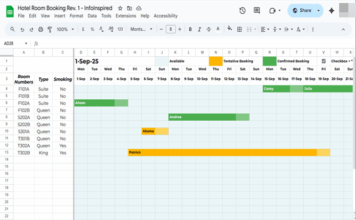

Want to visually group columns in Google Sheets—for timelines, project phases, or budgeting categories? In this tutorial, you’ll learn how to highlight N columns alternatively in Google Sheets using conditional formatting.
This means highlighting blocks of columns (e.g., the first 2 columns), skipping the next N columns, then highlighting the next N, and so on.
You can customize the block size by setting N to any number of columns, and optionally control it from a cell.
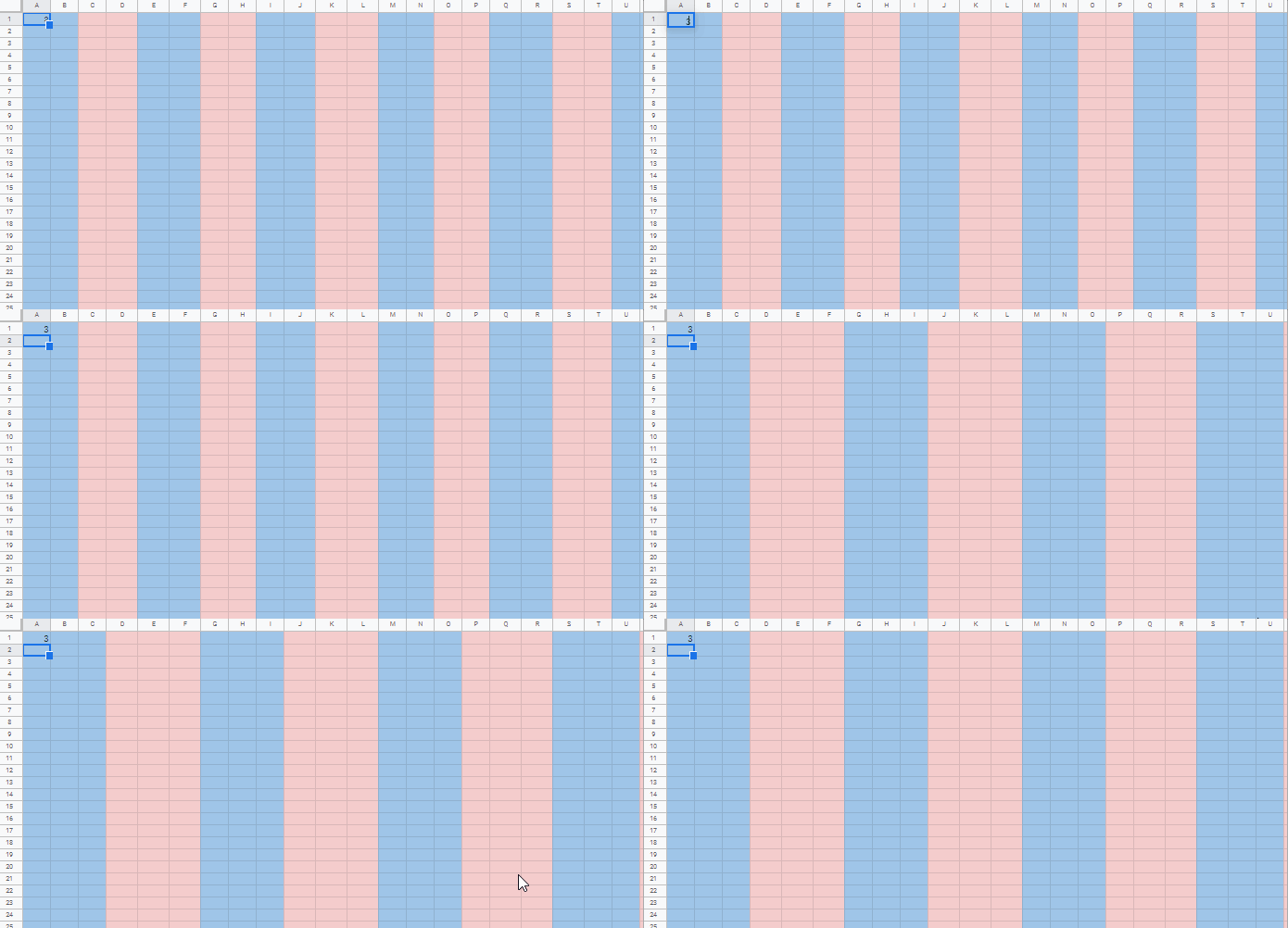
Example: Highlight N Columns Alternately in Google Sheets
Let’s say N = 2. With the formulas provided below, columns A and B will be highlighted in light blue, C and D in light red, E and F in light blue again, and so on — creating a clear alternating pattern of column groups.
You can also make this behavior dynamic by referring to a cell (like A1) that holds the N value.
Conditional Formatting Formulas
Apply the following rules to a range like A1:Z1000. You can later adjust the range as needed.
Before applying the rule, enter the number of columns to group (N) in cell A1. For example, enter 2 to highlight every alternate set of 2 columns.
Rule #1 – Light Blue Background
=MOD(COLUMN(A1)-COLUMN($A$1), $A$1*2) < $A$1Explanation:
This formula checks if the current column falls within the first N columns of each 2N group. It uses the MOD function to cycle through blocks of 2×N columns and highlight the first N in each block.
Rule #2 – Light Red Background (Optional)
=MOD(COLUMN(A1)-COLUMN($A$1), $A$1*2) >= $A$1Explanation:
This highlights the alternate group — the second set of N columns in each 2N block. If you’re using two colors, apply this as a second rule.
Dynamic Control of N Using a Cell
In both formulas above, $A$1 refers to the cell where you can enter the value of N. This allows you to change the group size at any time.
| A1 Value | Highlighting Pattern |
|---|---|
| 1 | Every other column (A, C, E, …) |
| 2 | Every alternate set of 2 columns (A–B, E–F, …) |
| 3 | Every alternate set of 3 columns (A–C, G–I, …) |
| … | And so on |
To make the formatting static (non-dynamic), simply replace $A$1 in the formulas with a number (e.g., 2 or 3).
How to Apply the Conditional Formatting Rules
Follow these steps to set up the alternating group highlighting in Google Sheets:
- Select the range — for example,
A1:Z1000. - Go to Format > Conditional formatting.
- Under Format cells if, choose Custom formula is.
- Paste the Rule #1 formula and choose a fill color (e.g., light blue).
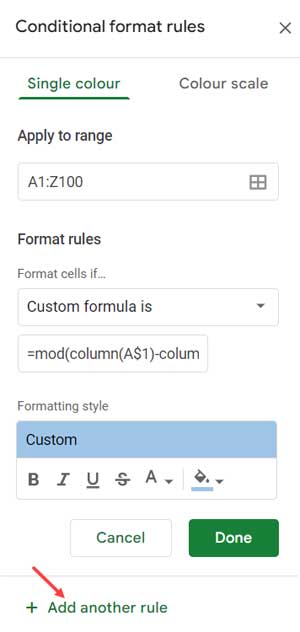
- Click Add another rule.
- Paste the Rule #2 formula and choose a second fill color (e.g., light red).
- Click Done.
- In cell
A1, enter the desired block size — try entering 3 and observe the alternating column highlights.
Highlight N Columns Alternately Starting From a Different Column
You might want to skip certain starting columns like A to C and begin the formatting from column D instead.
To do that, use the formulas below:
Light Blue:
=MOD(COLUMN(D1)-COLUMN($D$1), $A$1*2) < $A$1Light Red:
=MOD(COLUMN(D1)-COLUMN($D$1), $A$1*2) >= $A$1- Apply these formulas to the range
D1:Z1000. - Then enter 5 in cell
A1to highlight every other block of 5 columns starting from column D.
Conclusion
Highlighting N columns alternately in Google Sheets makes timelines, project phases, and grouped data easier to read and visually appealing. Whether using a fixed block size or a dynamic value from a cell, this technique gives you full control over column grouping.
For more tips and 80+ Conditional Formatting tutorials—covering rows, columns, groups, min/max values, duplicates, and more—check out the full hub: The Ultimate Guide to Conditional Formatting in Google Sheets.