
We can use the ISTEXT function to highlight text entries in a range in Google Sheets. This helps identify data inconsistencies.
Highlighting text entries in a range can assist with data cleaning. Issues may arise when numbers or dates are mistakenly formatted as text, leading to invalid calculations. You can easily identify and resolve these issues by using conditional formatting to highlight text in a formula’s range.
Steps to Highlight Text Entries in a Range
- Select the column, row, or 2D array where the highlighting applies. For this example, we’ll select the range A1:B6.
- Click on Format > Conditional Formatting.
- In the sidebar panel, choose Custom Formula is under Format Rules.
- Enter
=ISTEXT(A1)(use the cell reference of the top-left cell in your selected range). For example, if you’re highlighting the range B5:B100, use=ISTEXT(B5)in the formula field. - Choose a fill color under the Formatting style.
- Click Done.
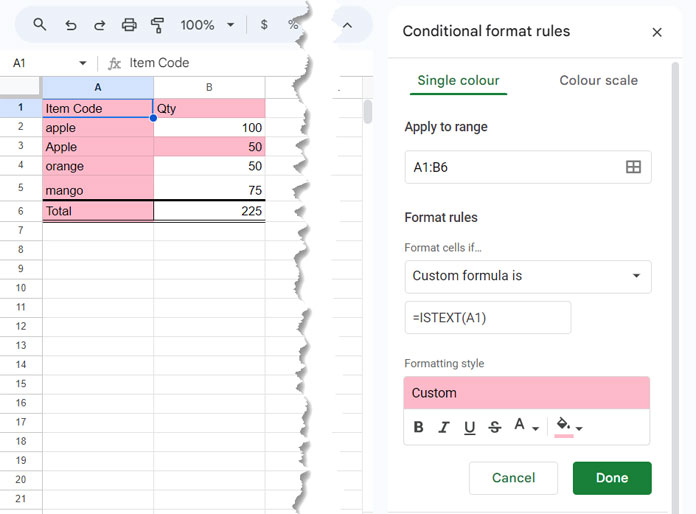
This will highlight only text entries in the selected range in Google Sheets.
Additional Tip: Highlighting Text Starting with Lowercase Letters
As part of data cleaning, you might want to highlight only text entries that start with lowercase letters.
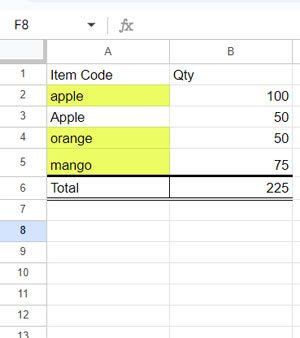
The steps for highlighting are the same as in our previous example. The only change is in the custom formula. You can use this formula:
=AND(
   IFERROR(VALUE(A1), " ")=" ",
   EXACT(LEFT(A1, 1), LOWER(LEFT(A1, 1)))
)
Let me explain this rule:
IFERROR(VALUE(A1), " ") = " "– checks if the output is" ", identifying text (not numbers formatted as text).EXACT(LEFT(A1, 1), LOWER(LEFT(A1, 1)))– EXACT tests if the first character in cell A1 matches its lowercase version. If TRUE, the text starts with a lowercase letter.
The AND function ensures that both conditions are met: the cell contains text (not a number formatted as text), and it starts with a lowercase letter.
This method highlights only text entries that start with a lowercase letter.
Conclusion
Using conditional formatting with the ISTEXT function, you can easily highlight text entries in Google Sheets and identify data inconsistencies. This is especially useful for data cleaning and ensuring accurate calculations in your spreadsheets.
For more tips and examples, see The Ultimate Guide to Conditional Formatting in Google Sheets, where this tutorial is also included.