















The RANDARRAY function in Google Sheets is the array-based version of the popular RAND function. Both are volatile functions and are categorized under the Math function family in Google Sheets.
While the RAND function generates a single random number between 0 and 1, the RANDARRAY function outputs a dynamic array of random numbers—filling multiple rows and columns with values between 0 and 1.
Unlike in Microsoft Excel, where RANDARRAY allows specifying minimum and maximum values (like RANDBETWEEN), the RANDARRAY function in Google Sheets only supports the row and column arguments. More on that below.
What Is a Volatile Function?
Volatile functions recalculate every time the spreadsheet is edited or reopened. This means the results of the RANDARRAY function will change with each action taken in the sheet—even if unrelated to the formula.
Syntax of RANDARRAY in Google Sheets
RANDARRAY(rows, columns)- rows – The number of rows to return.
- columns – The number of columns to return.
Example:
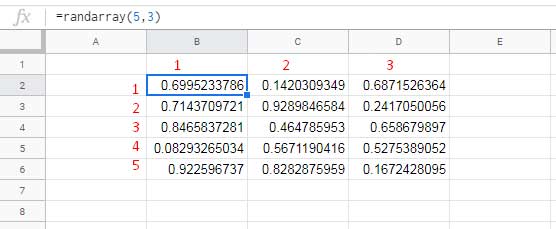
=RANDARRAY(5, 3)This formula generates a 5-row by 3-column array of random numbers between 0 and 1.
Practical Uses of the RANDARRAY Function in Google Sheets
The RANDARRAY function in Google Sheets is useful in scenarios that require randomization. Here are a couple of real-world examples:
1. Randomize a Data Range
Imagine you have a list of names and ages in cells A2:B11. You can shuffle this range randomly using:
={"Name", "Age"; SORT(A2:B11, RANDARRAY(10, 1), TRUE)}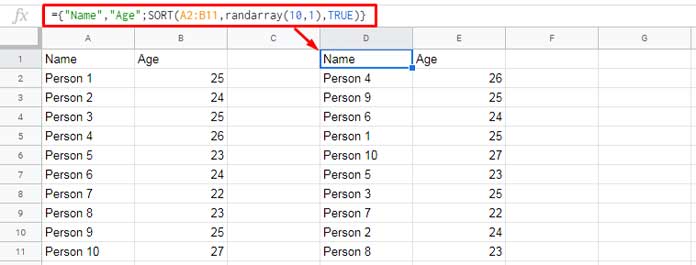
Explanation:
RANDARRAY(10, 1)creates a helper column with 10 random numbers (for each row inA2:B11).- This random column is used to sort the original data.
SORTthen reorders the rows based on these values.- The header row is manually added using array notation.
2. Extract ‘n’ Random Rows from a Range
You can combine RANDARRAY, SORT, and ARRAY_CONSTRAIN to extract a specific number of random rows:
=ARRAY_CONSTRAIN({"Name","Age"; SORT(A2:B11, RANDARRAY(10, 1), TRUE)}, 6, 2)This formula returns 5 random rows plus the header (6 rows total, 2 columns wide).
Comparison: RANDARRAY vs RAND vs RANDBETWEEN in Google Sheets
| Function | Description |
|---|---|
RAND() | Returns a single random decimal between 0 and 1. |
RANDARRAY() | Returns an array of random decimals between 0 and 1. |
RANDBETWEEN() | Returns a random integer between specified low and high values. |
Although RANDBETWEEN can’t generate arrays directly, you can simulate it using ARRAYFORMULA and SEQUENCE:
=ARRAYFORMULA(RANDBETWEEN(1, ROW(A1:A5)))
=ARRAYFORMULA(RANDBETWEEN(1, SEQUENCE(5)))
Note: These can result in duplicate values, making them less ideal for tasks like shuffling or sampling without repetition.
A Note About Excel
In Excel, the RANDARRAY function allows specifying minimum and maximum values, and whether you want decimals or integers:
=RANDARRAY(10, 1, 1, 100)This would generate 10 random numbers between 1 and 100 in a single column—but this feature is not supported in Google Sheets.
Related Reading
- Pick a Random Name from a Long List in Google Sheets
- How to Shuffle Rows Randomly in Google Sheets
- Google Sheets: Macro-Based Random Name Picker
- How to Randomly Select N Numbers in Google Sheets
- How to Randomly Extract a Certain Percentage of the Rows in Google Sheets
- Generate Odd or Even Random Numbers in Google Sheets
- Pick Random Values Based on Condition in Google Sheets
- Interactive Random Task Assigner in Google Sheets
- How to Generate Random Groups in Google Sheets
- Generate Unique Random Numbers in Excel with Dynamic Arrays
