
When working with financial data in Google Sheets, it’s important to present numbers in a readable currency format. While you can use the menu option Format > Number > Currency, there’s a more dynamic and formula-driven way to format numbers as currency.
In this guide, you’ll learn how to:
- Use the
TO_DOLLARSandDOLLARfunctions in Google Sheets - Format plain numbers as currency using formulas
- Understand the difference between the two functions
- Choose the right function based on your specific needs
Use Case: Calculating Total Cost in Currency Format
Assume you’re tracking purchase quantities of an item in column B, and the unit rate is $5.
Basic formula to calculate total cost:
=SUM(B2:B10) * 5This returns a plain number, not a currency-formatted one.
To format this result as currency using a formula, wrap it with either TO_DOLLARS or DOLLAR:
=TO_DOLLARS(SUM(B2:B10) * 5)How to Use TO_DOLLARS in Google Sheets
The TO_DOLLARS function converts a numeric value into your sheet’s default currency format (based on your locale).
Syntax
TO_DOLLARS(value)Examples
=TO_DOLLARS(A1)
=ArrayFormula(TO_DOLLARS(A1:A10))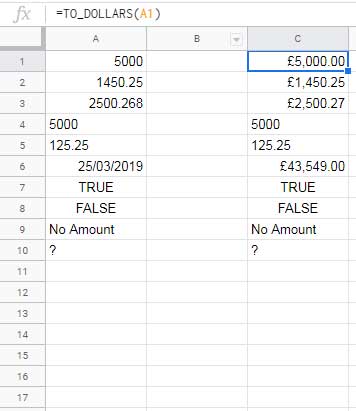
Behavior
- Accepts only numeric input.
- Returns output in currency format, but still a number (not text).
- Returns text inputs as-is (no conversion applied).
- Interprets dates as numbers—not recommended for date fields.
Pro Tip: Use TO_DOLLARS when you want the formatted result to still behave like a number (for calculations, charting, etc.).
How to Use DOLLAR in Google Sheets
The DOLLAR function is more flexible with input types and allows for rounding.
Syntax
DOLLAR(number, [number_of_places])Examples
=DOLLAR(1234.567)        → "$1,234.57"
=DOLLAR(1234.567, 0)     → "$1,235"
=ArrayFormula(DOLLAR(A1:A10))
Behavior
- Converts numbers and numeric text to currency format.
- Returns text (not a number).
- Accepts Boolean values (TRUE/FALSE) and formats them.
- Throws #VALUE! error if input is pure text.
Note: Use DOLLAR when you need to display currency in text format or apply rounding.
TO_DOLLARS vs DOLLAR: Quick Comparison
| Feature | TO_DOLLARS | DOLLAR |
|---|---|---|
| Output format | Number | Text |
| Accepts text input | ❌ Returns as-is | ✅ Converts to currency format |
| Works with Boolean (TRUE/FALSE) | ❌ Returns as-is | ✅ Formats as currency |
| Interprets date values | ✅ Converts to currency (⚠️) | ✅ Converts to currency (⚠️) |
| Rounding option | ❌ Not available | ✅ Yes, via second argument |
| Use in charts/calculations | ✅ Recommended | ❌ Not ideal (text output) |
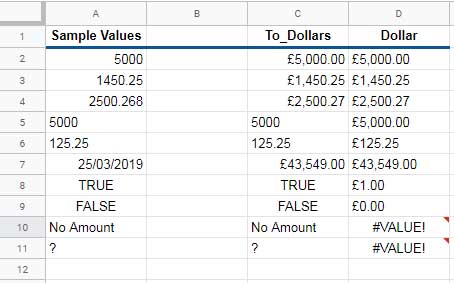
In the screenshot below, you can see how the TO_DOLLARS function (left column) and the DOLLAR function (right column) format the same input data differently. This highlights the key differences in output type, handling of text values, and formatting behavior.
Example: Format Total Purchase Cost as Currency
Let’s apply what we’ve learned.
Plain formula:
=SUM(B2:B10) * 5With TO_DOLLARS:
=TO_DOLLARS(SUM(B2:B10) * 5)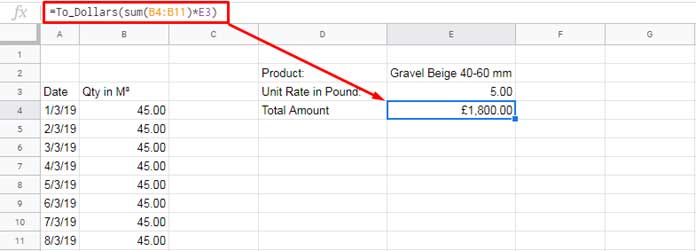
This version ensures the output remains a number in currency format, perfect for additional calculations or chart visualization.
If you need to display the value as text or round to specific decimals, use:
=DOLLAR(SUM(B2:B10) * 5, 0)When to Use Each Function
- ✅ Use
TO_DOLLARSwhen:- You want a number output.
- You need to retain numeric behavior for formulas or charts.
- Input values are strictly numbers.
- ✅ Use
DOLLARwhen:- You want rounded currency values.
- You’re converting numeric text to currency format.
- You’re displaying currency as plain text.
Related Tutorials
- Lookup Dates and Return Exchange Rates in Google Sheets
- How to Set Your Country’s Currency Format in Google Sheets
- Currency Conversion in Google Sheets Using GOOGLEFINANCE
- Convert Currency-Formatted Text to Numbers in Google Sheets
- Extract Numbers Prefixed by Currency Signs from a String in Google Sheets
- Currency Formatting in Google Sheets Drop-Downs
- How to Use the BAHTTEXT Function in Google Sheets