













Managing projects in Google Sheets often requires a clear visual timeline, and Gantt charts are one of the best ways to achieve this. Instead of building them manually with formulas or formatting tricks, you can use the GANTT_CHART named function in Google Sheets to generate them automatically.
This function expands task dates into bars, making it easier to track schedules, compare planned vs. actual progress, and keep projects organized—all with a single formula.
Data Requirements for the GANTT_CHART Function
Before using the function, make sure your sheet includes:
- A task name column and corresponding start date and end date columns
- Project start and end dates (timeline)
- Project duration in number of days
- A status column (optional) for applying different colors to bars based on task status
- A timescale that spans from the project start date to the project end date
Once you set these up, you can create an automatic Gantt chart in Google Sheets with the GANTT_CHART named function.
Syntax of the GANTT_CHART Named Function in Google Sheets
GANTT_CHART(start_date_range, end_date_range, from, to, duration, status)Arguments
- start_date_range → The range containing task start dates
- end_date_range → The range containing task end dates
- from → Timescale start date (cell reference or hard-coded date)
- to → Timescale end date (cell reference or hard-coded date)
- duration → Total project duration in days
- status → Task status column range – if there is no status column, simply refer to the task column
How to Get the GANTT_CHART Named Function
The GANTT_CHART function is a custom named function, not a built-in feature of Google Sheets. You can import it from a ready-made sheet instead of creating it manually.
- Make a copy of my sample Google Sheet.
- Once copied, the GANTT_CHART named function will automatically be available in that sheet.
- You can then use
=GANTT_CHART(...)just like a regular formula.
To use the function in another file: open the spreadsheet where you want the function to be available (the destination file). Then go to Data > Named functions > Import functions. In the import dialog, select the copied sample file, choose GANTT_CHART from the list of functions, and click Import. The GANTT_CHART named function will be added to the current (destination) sheet and can be used there immediately.
Steps to Automatically Create a Gantt Chart in Google Sheets
Step 1: Enter task details
In columns A–C, enter your task name, start date, end date, and (optionally) task status.
Example:

Step 2: Project timeline
Enter the project start and end dates. For example:
- B1 →
=MIN(B4:C11) - C1 →
=MAX(B4:C11)
This will return the earliest start and latest end dates automatically.
Step 3: Project duration
The duration is the total number of days (inclusive). Enter this in C2:
=C1-B1+1In our example, the project runs for 79 days.

Step 4: Create the timescale
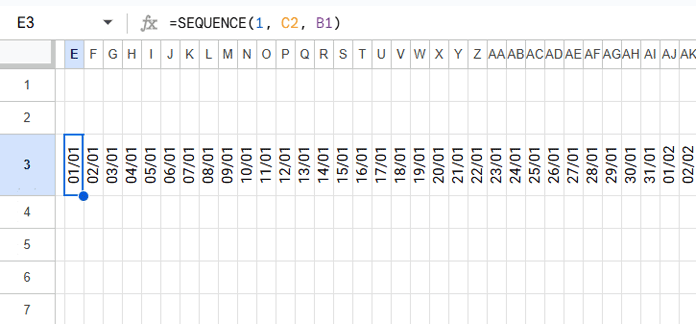
We now need a row of dates across the chart. In E3, enter:
=SEQUENCE(1, C2, B1)This will expand the project timeline across columns, from the start to the end date. You can optionally format the dates to DD/MM under Format > Number > Custom number format and apply Rotate Up under Format > Rotation for a cleaner Gantt chart view. Further, adjust the column width uniformly to the minimum for a compact timeline display.
Step 5: Prepare the chart area
For each task row, merge the corresponding timescale columns (E through CE).
- Select the range (e.g., E4:CE4)
- Click Format > Merge cells > Merge horizontally
- Repeat this for each task row. To save time, you can simply copy and paste the first merged row down.
Step 6: Apply the GANTT_CHART function
In E4, enter:
=GANTT_CHART(B4:B11, C4:C11, B1, C1, C2, D4:D11)Where:
- B4:B11 → Task start dates
- C4:C11 → Task end dates
- B1, C1 → Project start and end dates
- C2 → Project duration
- D4:D11 → Task status column

Default Color Schemes for GANTT_CHART in Google Sheets
By default, the GANTT_CHART function supports the following status-based colors:
- Complete →
#4CAF50(green) - Upcoming →
#90CAF9(light blue) - In Progress →
#FF9800(orange) - Hold →
#9E9E9E(neutral gray)
If you want to show both the planned schedule and the actual progress for each task, the function also supports:
- Sch →
#9E9E9E(neutral gray) - Actual →
#1976D2(blue)
If no status is provided (either by referring to an empty range or by pointing to the task range itself), all bars appear in dark teal #005B70.
The default background is white, but you can customize these colors by editing the named function under:
Data > Named functions
Look for this part in the formula within Data > Named functions:
{"charttype","bar";
 "color1","white";
 "color2",switch(s,
   "Complete","#4CAF50",
   "Upcoming","#90CAF9",
   "In Progress","#FF9800",
   "Hold","#9E9E9E",
   "Sch","#9E9E9E",
   "Actual","#1976D2",
   "#005B70")}
Related Tutorials on Gantt Charts in Google Sheets
- Create Gantt Chart Using Formulas in Google Sheets
- Creating a Gantt Chart with Stacked Bar Chart in Google Sheets
- How to Create a Gantt Chart with Sparkline in Google Sheets
- Split a Task in Gantt Chart in Google Sheets
- Multi-Color Gantt Chart in Google Sheets
- Days Remaining in Gantt Chart in Google Sheets
- How to Apply a Date Filter in a Gantt Chart in Google Sheets
- Track Remaining Days in Tasks with Sparkline Gantt Charts
